Loading
Back to projects
2026
Final Year Project
Optimizing Traffic FLow using Reinforcement Learning
pythonAI developmentai architectureppolce
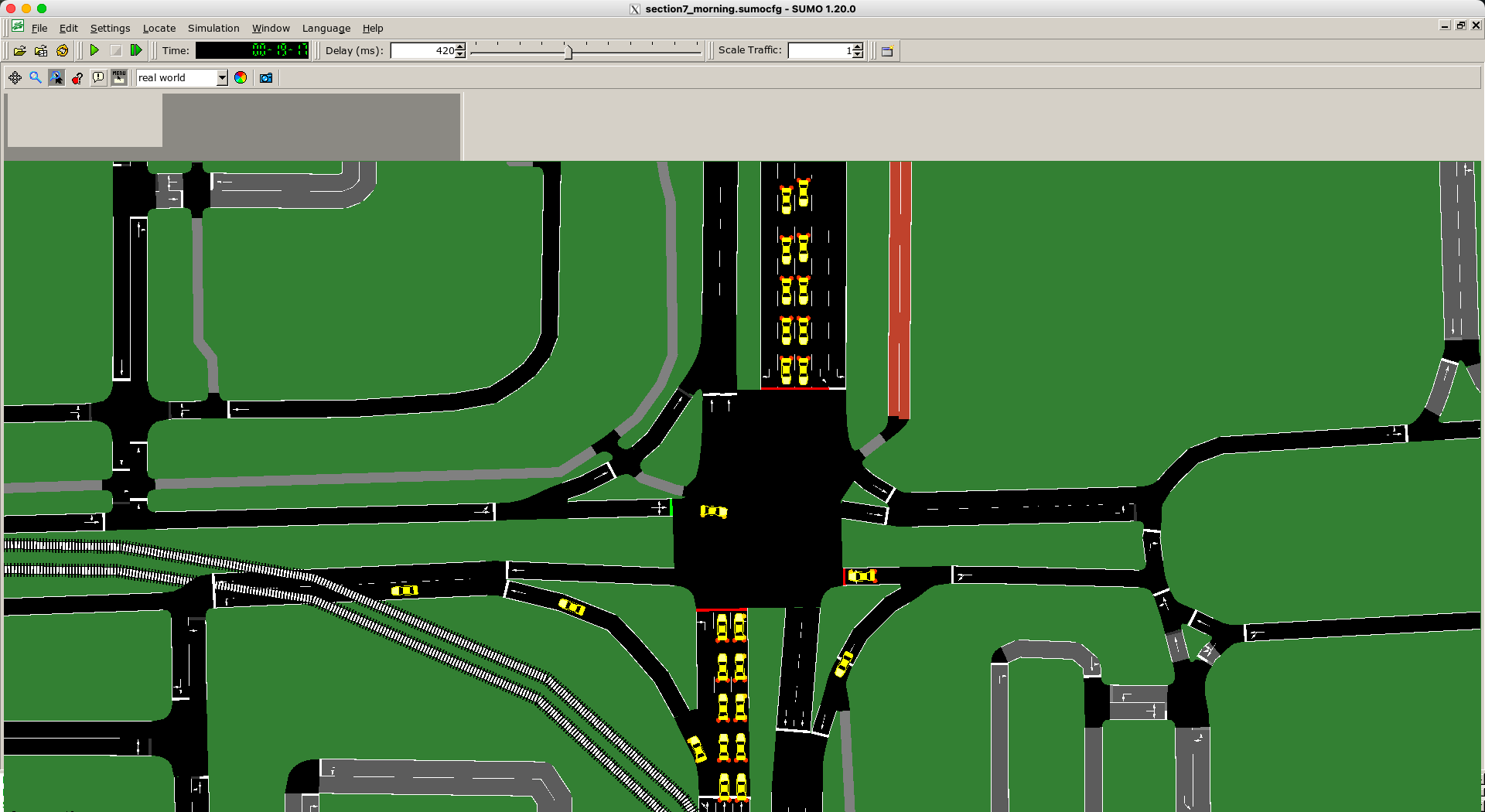
IntelliGrid is my final-year Computer Science project at Universiti Teknologi MARA (UiTM), Shah Alam. It explores how artificial intelligence can make traffic signals more responsive to changing traffic conditions, using the Section 7 intersection at Persiaran Kayangan and Persiaran Permai as its case study.
The project uses reinforcement learning, where an AI agent learns through trial and feedback. Inside a traffic simulation, the agent observes queue lengths, vehicle waiting times, traffic density, and the current signal phase. It then learns signal-control decisions aimed at reducing unnecessary waiting.
The controller uses Proximal Policy Optimization (PPO), implemented in Python with PyTorch. It connects to SUMO, a traffic simulator, to train and evaluate its decisions without affecting real road users. The project also includes traffic-demand profiles derived from recorded morning, midday, and afternoon observations at the intersection.
A central part of IntelliGrid is Lagrange Constraint Enforcement (LCE). This adds an adaptive penalty for minimum-green-time violations, allowing the project to investigate how a learning controller can balance traffic efficiency with operational requirements.
The thinking
Process & trade-offs
01
Can traffic lights respond better to the traffic that is actually there?
A fixed-time signal follows a predetermined schedule. That schedule may suit one traffic pattern but become less effective when demand changes. One approach might develop a long queue while another receives more green time than it needs.
Reinforcement learning offers a way to explore a more adaptive approach. Instead of manually specifying every timing decisiA fixed-time signal follows a predetermined schedule. That schedule may suit one traffic pattern but become less effective when demand changes. One approach might develop a long queue while another receives more green time than it needs.
Reinforcement learning offers a way to explore a more adaptive approach. Instead of manually specifying every timing decision, the controller learns from the consequences of its actions.
However, reducing waiting time alone is an incomplete objective. A controller also needs to account for operating constraintson, the controller learns from the consequences of its actions.
However, reducing waiting time alone is an incomplete objective. A controller also needs to account for operating constraints
02
Can an AI controller improve traffic flow while learning to respect those constraints?
To study this, the project compares a fixed-time controller, PPO without constraint enforcement, and PPO with LCE. Evaluation considers vehicle delay, queue length, throughput, and constraint violations, so performance is assessed beyond a single score.
The scope is deliberately focused on one intersection. This makes it easier to examine the controller’s behaviour and understand the trade-offs before considering a larger road network.
IntelliGrid is a simulation-based research project. Its purpose is to investigate how adaptive learning and explicit constraints can work together toward more practical traffic-signal control.
The results
Outcomes
So, what's the result?
that's something you guys have to wait. this project is active in development and model training is in-progress.